
The Parish in New-France
This text is taken from the book "Chez nos ancêtres" by Canon Lionel Groulx. It clearly shows the importance our ancestors placed on parish life, something that can be inspiring to us today.
It was in and around the church, nevertheless, that parish life was lived most intensely. The steeple dominated everything in the parish, just as faith dominated everything in men’s souls. Our forefathers knew even better than we do how beneficent and motherly the Church was to them. In the early days, before the church itself had yet been built, had they not seen the Church establish herself everywhere, with her rites and mysteries, in the Canadian cottage? Was it not, indeed, the Church alone that constituted the parish community? What else provided a bond and a government among all those families—related to one another in large groups, it is true, yet independent of one another and scattered along the river settlements? There were no municipal institutions to raise a few leaders above the mass and bind them together into a community. The Church was the one centre; the parish priest was the one leader who gathered the little family communities into unity. Thus the only authority that presented itself to these groups, binding them together and providing for their needs even in temporal matters, appeared before them invested with a sacred character. The very principle of authority was thereby impressed more deeply upon the souls of our forefathers. And what social cohesion must have existed among families for whom charity and solidarity were raised into the supernatural order, and whom faith made conscious of being closely united even with their dead!
The Canadian loved his church first of all, no doubt, for reasons of faith; but he loved it also because the gathering on Sundays and feast days made the brotherhood of society something tangible to him. Before the altars and at the foot of his pastor’s pulpit, he felt himself to profess the same doctrine, belong to the same communion, and submit to the same authority as all his brethren; he felt himself bound by the same tradition and joined to the same family as all the generations that had passed away. The parish became, in his eyes, simply an enlarged family.
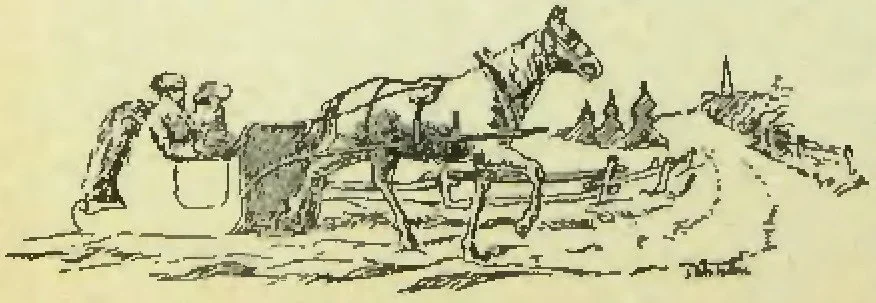
In the same way, the splendours of the liturgy remained the most beautiful and moving spectacles to his simple Christian soul. And so he never missed Mass, however far he might live from the church. As the hour approached for the last bell to ring, one could see the long procession of horse-drawn vehicles coming in along the country roads. Those who lived farthest away were often the first to arrive. It was a fine opportunity to put one’s horses through their paces, and they came along at a lively speed, the father generally standing at the front of the carriage—or of the sleigh in winter—with the reins in his hands. In summer, when the roads were impassable, they often travelled on horseback, with the wife riding pillion behind her husband.
Franquet witnessed just such a scene at Saint-Sulpice in 1753, where the young dandies of the parish, wearing their hair in a black pouch, embroidered hats, shirts with cuffs, and leggings on their legs, carried their sweethearts pillion to church. Dr. Hubert La Rue relates that at the beginning of the nineteenth century the custom still survived on the Île d’Orléans of going on horseback to the St. John’s bonfire, with the women riding pillion behind their husbands.
People also came to church on foot. The habitant would walk miles and leagues barefoot or in his work shoes. When he drew near the church, he sat down beside the road and reverently put on the fine French shoes that he had carried beneath his arm. Thus arrayed in all his finery, though perhaps a little unsteady on his high heels, at the call of the church constable he entered the house of the good God, “where Mass was about to begin.”
The “womenfolk” had entered first, just as they would be the last to leave. Some had come in dresses, but many others were clothed much as they were during the week, wearing a small, elegant short mantle over a short petticoat drawn tight at the waist. For walking among tree stumps and along the roads of those days, our great-grandmothers evidently did not find a constricting dress particularly practical. They often wore a silver cross around the neck, and all of them made up for any simplicity of dress by the care they lavished upon their hair. Kalm, who seems to have found this somewhat irritating, claims that Canadian women took infinite pains over their hair: “they dress and powder it every day and put it into curl-papers every week.” But let us follow this whole company into the church.
Ah, those churches of former days! Our ancestors certainly deserved some credit for going to them. They were neither rich nor beautiful, and in winter they were as cold as the North Pole. Not one was heated; there was not so much as a fire in the churches of Canada before 1815—as though the Roman rite had to be observed even to this final degree of rigour.
Bishop Hubert assures us, in a report to the Holy See, that divine worship was celebrated with greater majesty in the churches of Canada than in many dioceses of Europe. Yet one cannot help recalling, with a certain uneasiness, the picturesque spectacle presented by all those people bundled tightly in their hoods, shifting from foot to foot to keep from freezing solid, coughing, spitting, and puffing out clouds of vapour like so many chimneys or censers; while at the choir stand the cantors, their heads covered with enormous square caps and wrapped in heavy buffalo coats, over which had been carelessly thrown a surplice that had not seen the laundry for some time and a gown reaching only halfway down their legs, displayed boots or moccasins of freshly tanned reddish leather and, “with throats swollen and mouths flared like the bell of an ophicleide, hurled toward the vault of the sanctuary the opening notes of the Introit or the Dixit Dominus.”
Fortunately, the preaching of the parish priests of those days was generally warm—and the warmth lasted a long time. If the Sunday sermon and announcements had lasted less than an hour and a half or an hour and three quarters, the parishioners would say to one another as they left the church: “There must be something wrong with Father today.”
Those sermons contained a little of everything. The priests communicated the ordinances of the governors and intendants, and it was through their pastor that parishioners learned the news of the country and even of Europe. But the priest also preached doctrine and kept a jealous watch over the morals of his flock.
There were troubles in these little communities, particularly after the introduction of prisoners and the billeting of soldiers in the inhabitants’ homes. In the towns there were irregular so-called marriages à la gaumine—unions attempted by exchanging matrimonial consent in the presence of a priest but without his cooperation—which eventually had to be stopped under threat of excommunication. There were even duels between officers or soldiers.
The pastor’s admonitions could easily rise to great vehemence in an age when the threat of the most terrible punishments might be held over the heads of offenders. It was still the age of public penances, courageously imposed and courageously accepted. A woman of Lorette had been excommunicated for some scandal; having repented, she came to ask for her punishment. By order of the bishop, she was to stand at the church door throughout Mass with a lighted candle in her hand; in her name the parish priest would ask pardon for her offence from God, from the Church, and from all those present. Every Sunday from November 15 until Easter, the penitent woman was to attend Mass and Vespers inside the church, but at the door. She was likewise to fast every Friday until Easter; only after this long penance could she be admitted to Communion.
A severe punishment indeed—but mild compared with the sanctions of the secular criminal law of the time. In 1733, two persons in Quebec having been convicted of causing scandal, the intendant sentenced them
“to make public amends in their shirts, with ropes around their necks and holding in their hands a burning wax torch weighing two pounds, before the principal door of the cathedral church, and there, bareheaded and upon their knees, to declare in a loud and intelligible voice that wickedly and fraudulently they had profaned and abused the sanctity of the sacrament of marriage, that they repented of it and asked pardon of God.”
This done, added the intendant, they were to be beaten and flogged with rods by the executioner of high justice through the crossroads and customary places of the city, and banished for three years.
Would you like us to venture a little farther inside a church of the old régime? Many precious things, characteristic of the society of those days, have unfortunately disappeared with the coming of the new order, or during the past fifty years.
The social hierarchy was reflected in our old churches, the only places in which public life visibly displayed itself. The seigneur possessing the right of high justice, upon whose domain the church had been built, received particular honours there. Thus in every church one could see the seigneurial pew, on the right upon entering, four feet from the communion rail. It was the same width as the other pews but could be twice as deep. Co-seigneurs also had their pew, but after that of the high-justice seigneur; and the captain of the côte took his place after the seigneur.
All these personages enjoyed special privileges, set out in minute detail by royal regulations and decrees of the Superior Council. Every Sunday, for example, the faithful heard the parish priest, during the parish announcements, commend the high-justice seigneur and his family to their prayers.
On certain feast days, a strict order of precedence and a scrupulous ceremonial had to be observed. Candles, palms, ashes, and blessed bread were to be distributed first to the high-justice seigneur immediately after the clergy in surplices; then to the captain of the côte; then to the judges of the seigneury; and only after them to the churchwardens and to the cantors who were not wearing surplices. In processions, the seigneur, immediately followed by his sons, walked first behind the canopy. The lady of the manor and her daughters walked at the head of all the women. Thus the same order displayed itself outside the church as within it.
These minute regulations had only one fault: they abundantly nourished touchiness and a taste for litigation. Our old records are filled with echoes of these childish quarrels.
One seigneur, M. Descheneaux, demanded that the blessed bread be solemnly presented to him “upon a plate and beneath a napkin”; and, determined to have his way, he carried the matter all the way to the tribunal of Bishop Briand.
On another occasion, at Saint-Thomas and Saint-Pierre-de-la-Rivière-du-Sud, some cantors, unable to sleep for envy of a soldier’s laurels, decided that the blessed bread ought to be offered to them before it was offered to the captain of the côte. The parish priest refused. The cantors then conspired with Jean Marot, beadle of the said parish, and declared a strike at the choir stand. The case, if you please, was carried before Intendant Hocquart, who fined the strikers twenty livres, while leaving them free either to abandon the choir stand or to return to it.
Many ordinances of this sort were issued against those who refused, when their turn came, to provide the blessed bread.
Blessed bread! There is another old custom that is now almost gone. In the beginning people were content simply to offer ordinary homemade bread. In time, vanity crept in, and prosperous people—and others as well—began to provide sumptuous pastry cakes decorated with gold leaf cut into the shapes of beavers or maple leaves, built up in tiers and accompanied by special pieces known as cousins and a chanteau.
On Sunday the blessed bread was solemnly carried into the choir on a litter at the beginning of Mass to receive the blessing. The beadle and his assistants then distributed it. The cousins went to the cantors in surplices, to distinguished persons, and to relatives and friends; the chanteau went to the person whose turn it would be to provide the blessed bread next. Hence the popular expression passer le chanteau—“to pass someone the chanteau”—meaning to let a man know that his turn had come to do his part.
Another custom in which the Church took part, and in which the rural and religious elements were mingled, was the St. John’s bonfire. The St. John’s bonfire was held on the evening of June 23, the vigil of the feast of St. John the Baptist. The celebration went back to the earliest days of the colony, for according to the Relations a St. John the Baptist bonfire was held as early as 1636.
When the celebration took place in the church square, it was not lacking in solemnity. An octagonal pyramid some ten feet high was erected opposite the main door. It was made of cedar wood and covered with fir branches.
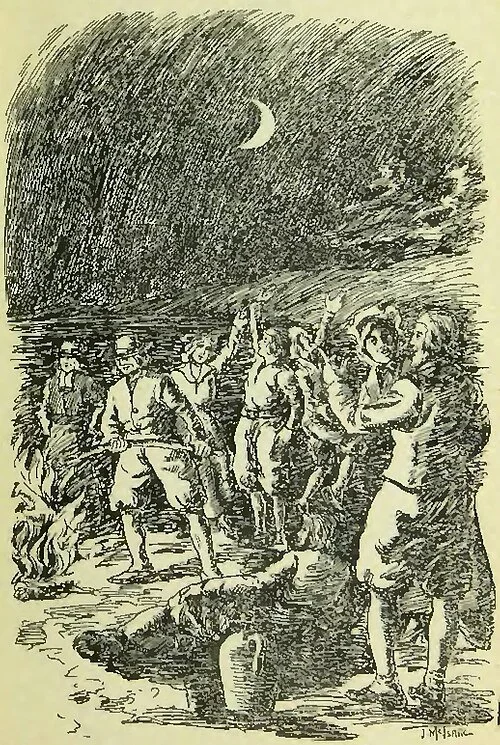
The ceremony began with Benediction of the Blessed Sacrament inside the church. Then the parish priest, accompanied by the clergy, came outside, recited the prayers prescribed by the ritual, and with a candle set fire to the wisps of straw arranged at each corner of the resinous pyramid.
In an instant a bright, crackling flame rose into the night, and cries of joy, acclamations, and gunshots continued for as long as the smallest spark of the St. John’s fire remained alight.
In the towns the celebration was conducted with still greater splendour. In Quebec in 1666, Bishop Laval attended the feast in pontifical vestments, accompanied by the whole clergy in surplices.
The bishop presented the white wax torch to M. de Tracy, who handed it back to him and insisted that the bishop should kindle the fire first.
With time, questions of precedence and disputes crept into this custom as they had into the others, and a strict protocol came to regulate the distribution of the torches. In the towns, at least three torches were needed if a St. John’s bonfire was to be conducted according to the rules: one for the governor-general, another for the intendant, and a third for the king’s lieutenant.
And despite all these precautions, it did happen from time to time that the fire broke out somewhere other than in the St. John’s pyramid.
In some rural districts, Edmond Roy tells us, the feast of St. John assumed a different character. It was celebrated with great bathings of children, who were plunged into the running waters of the river or into tubs filled with St. John’s wort. And in the evening bonfires were kindled upon the heights.
